I’m interested in two specific forms of protest and activism at the moment:
boycotts and strikes, and
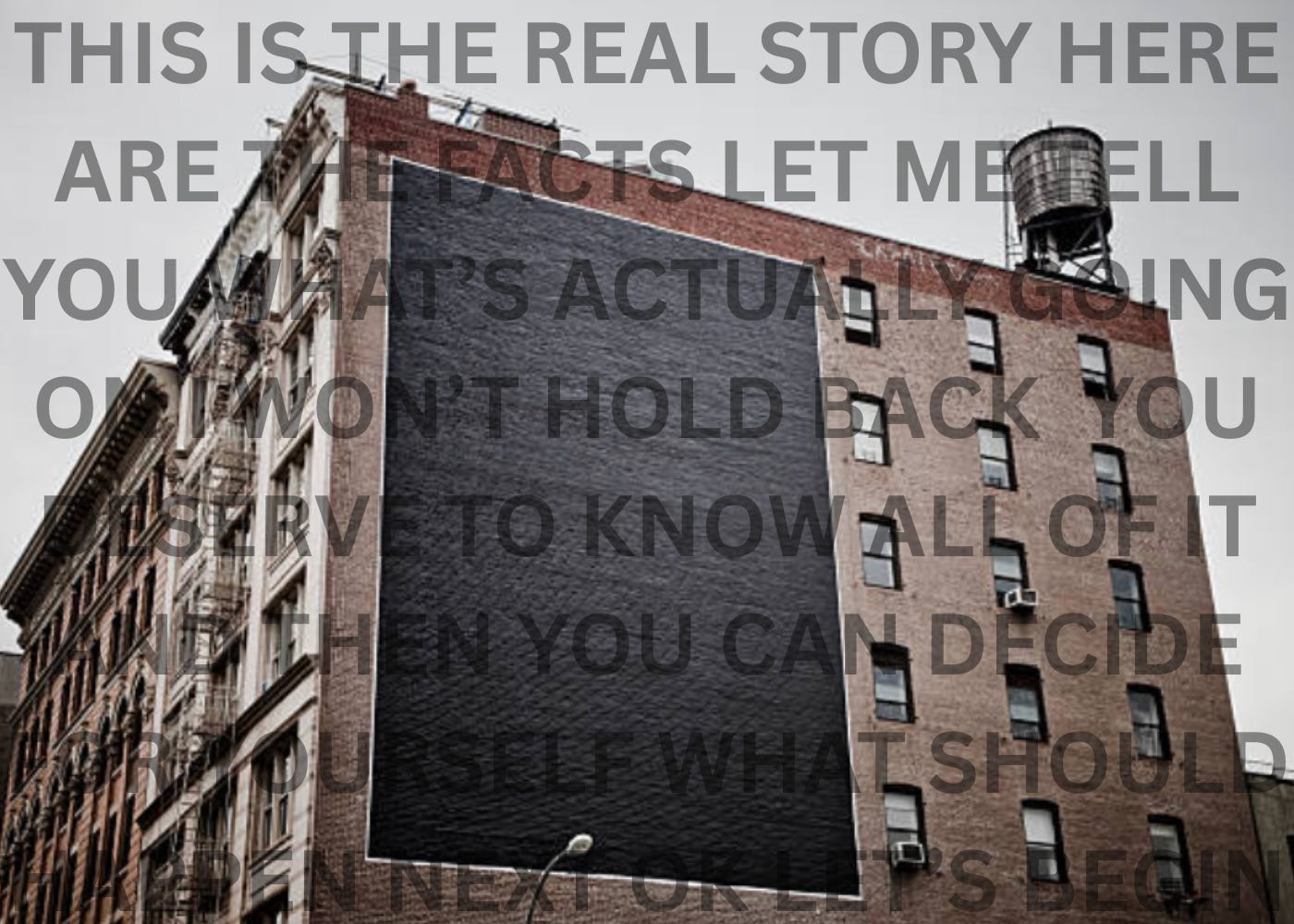
projection art.
I am not interested in one-and-done rallies though I understand their purpose, to show numbers and create the feeling of solidarity, but I’m interested in actions that have long-lasting leverage or reach people across dividing lines. Strike seems like one of the few points of leverage we the public still have, to directly affect the corporations who are amassing power at laborer’s expense and negatively influencing politics at the same time.
Next week a nationwide general strike is taking place, led by a coalition of grassroots groups including an organization called Blackout the System. The “economic blackout” is set to take place from Tuesday November 25 to Tuesday December 2nd.
Instructions are:
to refrain from working as much as possible, a recommendation which varies depending on a person’s situation. It helps that it’s happening over a long holiday weekend, which I’m sure was part of the plan.
Don’t spend any money at the businesses held by major corporations. Shop local if you need to shop.
Avoid travel or dining out. Again, unless it’s with small “mom & pop” businesses.
Cancel streaming or digital subscriptions if possible.
This is also intentionally happening over “Black Friday,” the kickoff to holiday shopping. I really love the idea of interrupting this tradition. One time as a teenager I trailed along with my best friend and her mom as they woke up early to hit the mall for black friday deals (this was pre-internet). I found it all so strange and uncomfortable, the celebration of capitalism and the way we were meant to feel like we were winning even if it was just some price adjustment that the marketing folks had calculated would make us buy things we didn’t know we needed.
I’ve also talked to my family about reducing gift-giving this year, focusing just on the kids instead and suppressing the urge to give everyone something, just because. They’re on board, and I’m not sharing this as a virtue-signal but as proof that it is possible to downsize our participation in these things. We agreed that if we spotted something that deeply inspired us — a piece of art, for example — exceptions were acceptable. The point is to break the cycle of checking boxes, shopping down a list and buying much more than we used to or needed to, out of a sense of balance or fairness or just habit.
It sounds like economists aren’t convinced it will make a meaningful impact, but this is the kind of practice I’m interested in: building the muscle of withdrawing from the treadmill of consumption and reminding corporations that we massively outnumber them and their paychecks and dividends are because of us. If we stop buying it, they stop earning it: full stop.
It’s been working at Target, where boycotts began after a 2023 pride month in which conservatives rejected their pro-LGBTQ+ choices, then progressives rejected Target’s attempts to pivot and walk it back. Many more dropped Target when they unapologetically ended their DEI policies right around the start of the DT administration’s loud anti-DEI proclamations in early 2025. By September Target’s stock had dropped 33% and lost more than $20 billion in shareholder value. I’ve managed to not spend money at Target since this all went down in January, a decision that has created zero hardship in my life.
The second idea motivating me right now is projection art, as a way to get offline and a workaround to our siloed messaging channels. In this slippery news environment, where every fact about what’s going on is subject to the messenger delivering it, I want to see more points of view reflected in the areas of the country largely tuning into the Fox News POV.
I think folks would want to know, for example, that congresspeople like House speaker Mike Johnson get a $92 per diem on days where they’re in DC, to reimburse the cost of a fancy lunch or dinner. They receive this on the same days that they take a pulpit arguing against giving low-income people SNAP payments averaging $2.11 per meal or just above $6 a day. 39% of all SNAP recipients are children, and nearly 86% of benefits go to households with a child, elderly adult, or disabled person living in it (ref here).
The Congressional meal stipend is almost 15 times the SNAP amount which, if the anti-SNAP Congresspeople think about it at all, must require playing mental gymnastics, confirming to themselves that they deserve this while others do not. Mike Johnson uses the argument, from his $223k/year position in a Congress that has worked less than 1/3 of this year’s workdays, that working class people are defrauding the system.
The scandal is not people taking advantage of SNAP. It’s that full-time workers can’t live without it (idea originally heard via Liz Plank in her post, Not to Be Woke But I Think Kids Should Eat).
I’ve noted a few effective projections lately, one that showcased images of Epstein and DT on the walls of Windsor Castle during a US visit, another that told the story of Elon on the side of a Tesla building. We’ve done them in the repro movement with phrases like “Abortion is Freedom” projected in different languages on the buildings of downtown New York. But I’m interested in seeing more of the Windsor and Tesla style projection art: reveals, fact-sharing, laying out stories that the public might not otherwise know in a format that’s impossible to ignore.
I’d be curious to see the facts about meal reimbursement projected on the wall of a building in Shreveport, Louisiana, the Speaker’s district. I wonder how people would respond.
Fact: Your rep [NAME] gets a $92 meal reimbursement in DC as he votes to limit $6 SNAP payments for low-income families.
Fact: Your rep [NAME] has comprehensive health insurance through the US government as he votes to inflate your health premiums by 18% to 114%.
As I write these out, it still sounds political, like an argument for one candidate or another. But there is a way of presenting the truth artfully and compassionately that just might break through. Projection art can rebalance the playing field, hold people accountable to the impact of their actions. These facts will never show up on Fox News, as it does not benefit the narrative. But civilians deserve to know about any instance of hypocrisy that directly impacts their lives. It’s time to explore creative ways of sharing information that does not rely on the channels of the internet or television: like light projections on blank building facades, bridges, the sides of trucks and vans.
Projections are captivating and insescapable. They play on the way the brain processes visual information faster than any other stimuli, and they don’t rely on breaking through media channels or paying tens of thousands in advertising fees. If they take place in a small town, they catch the passersby directly on their way to work, school, dinner.
Like any action, there is potential for consequences and the artist-activists must understand the risk. The four Windsor Castle artists were from a campaign group called Led By Donkeys, and were detained after the activation for reasons of “public nuisance and malicious communications.” They were ultimately not charged. I’m not sure of the UK’s free speech laws versus the US, but in the US if something is factual and is not presented as slander or causing immediate harm, it should qualify as free speech — at least for now. Which is why these facts should be amplified sooner than later.
I’m taking a local craniosacral therapy class this fall, to learn the fundamentals of giving craniosacral treatments. When friends ask, I tell them I was inspired to learn as part of my long arc of preparation for becoming a witchy old grandma, one who runs sound baths and tinctures and card pulls in her garden. Cranio involves gentle holds and manipulations of the skull and body to encourage the flow of craniosacral fluid, our body’s quieter and longer pulse (it’s quite amazing) and facilitating conditions for realignment, healing and vitality.
It’s an extremely subtle art, one requiring deep presence and listening and 1:1 attention. I find it to be an anecdote to our noisy chaotic world, a chance to listen to the immediate needs of another person’s body while also tuning in to the shared energetic field between. It requires trusting one’s intuition of what should happen next, and letting go of any expectation of fixing but instead allowing answers to arise. As usual, it contains metaphor upon metaphor for living.
My favorite part of the experience is the syrupy slowness of the class, in a dark low-ceilinged room with rows of massage beds and a balcony overlooking the downtown strip. By the end of a Friday afternoon, the ruckus outside is unavoidable: usually what sounds like a college marching band mixed with groups of friends walking and talking and cars revving their engines. Inside, we move between “listening stations,” from the heels to the hips to the cranium, creating gentle pressure on the skull plates creating slight changes in the sutures between them, shifts that feel so much bigger in the body than they are in real life - because it’s new information, and it’s vulnerable.
These are practices that cannot be scaled, they require individual attention and touch and I am only at the beginning of the learning journey. The medical terms for bones may be unfamiliar but the concepts click right away, harmonizing with ideas on healing I wrote about here, ideas on energy and potential and reorganization of matter. It’s adding a practical layer to my theoretical and spiritual exploration of what could be true. It also offers the brief rebellion of being off my phone, practicing presence and using my hands. I feel compassion for the soft, vulnerable bodies of my classmates and for my own. I zoom out in time and space and see us all on a longer arc of existence, one that has landed us here, now.
I wonder else can we get back to a shared reality. But this is one place I can start.
Backing track: Original music, Modal Cobalt8 and Moog Minitaur analog bass.